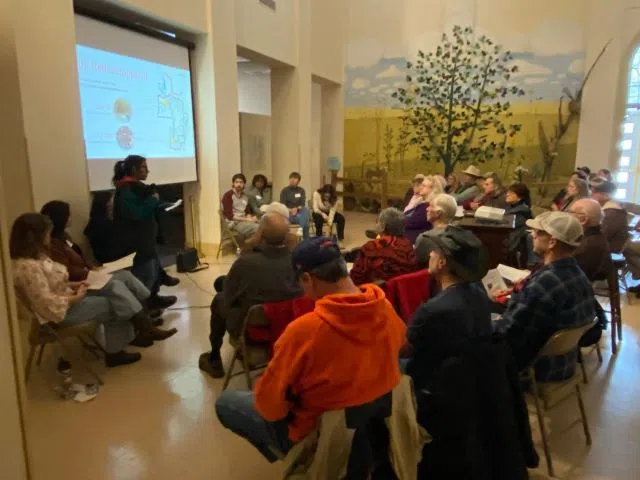
Some University of Illinois students think the history of coal mining in Vermilion County might be the key to attracting more tourists to our area. The students spent months exploring coal’s legacy in Vermilion County and presented their findings over the weekend at the Vermilion County Museum. Bill Pickett has more…
Professor Emily Guske outlined part of students’ findings…
{AUDIO: “They have identified sites in Vermilion County that they think are important to coal’s legacy and developed three different trails that focus on Labor History, the Middle Fork River, and the Evolution of Coal Mining Technology.”}
The students were asked to identify sites with significant connections to coal for Vermilion County’s Bicentennial Celebration.
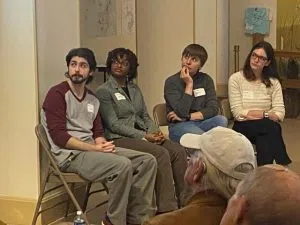
(Some of the students watch the presentation at the Vermilion County Museum.)
The students chose thirteen sites around Vermilion County as areas of interest for three eco-cultural heritage trails. As a top priority the students would like to see access restored for the area around Mine #6 adjacent to Kickapoo State Park…
{AUDIO: “That once was an active trail, but due to some infrastructural issues it isn’t completely accessible anymore. So, they’ve proposed that trail as being a shorter-term redevelopment. It’s like all of the bones are there, we just really need some funding and project management to get that back up and running.”}
The second-year Master of Urban Planning students feel a second priority should be attracting visitors to an underground petrified rainforest in southern Vermilion County…
{AUDIO: “This features the largest underground petrified rain forest in the world, with a huge collection of fossils. And they believe that this is something that could be nationally designated and draw people from across the country to see it.”}
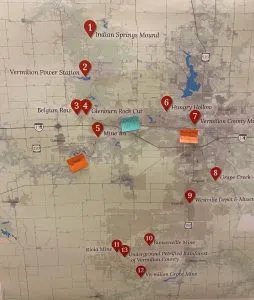 (The students have chosen 13 sites of interest along their proposed heritage trails.)
The students believe that even if the public cannot safely go underground to see the petrified rain forest…historical information above it would likely attract visitors. The underground fossilized rain forest was discovered in 2007 in the ceilings of the Riola and Vermilion Grove coal mines in southern Vermilion County. It is an estimated 300 million years old.
The students realize it may take years to implement any of their recommendations. They hope to recommend ways to improve policies addressing the impacts of mine and plant closings.
The project is a collaboration between the Urban Planning Department and the Climate Jobs Institute at the University of Illinois at Urbana – Champaign.