Fans of the NJCAA Division II Men’s National Basketball Tournament in Danville have been able to listen to and watch the games around the world this week. But as the radio and television coverage marks a 25 year milestone of covering the games, a lot has changed over the years.
Scott Eisenhauer is one of the WDAN radio broadcasters who also is one of the Tournament Directors for the games.
 ”When we first started out, we were the only ones doing any type of broadcasting. People would listen in on the radio,” said Eisenhauer. ”We did a little bit of television – not much. But – over time – streaming has become much more valuable as a tool to market the tournament as a whole. So now when we’re doing our radio broadcasts not only are people locally having the opportunity to hear it — and before maybe a station or two would pick it up — now, every game, people all across the country have the opportunity to listen to that particular broadcast.”
And since the games are also streamed, fans can listen around the world. And with that global audience, Eisenhauer says it makes him think.
”You have to start thinking differently about how you do the broadcast of the game – how you incorporate some of the national advertising messages that you need to read. And then, how to incorporate the local messages that we do…but also make sure it has an appeal to a national audience,” said Eisenhauer. ”So there’s a lot more to think about now – globally — than when we used to just put on a headset and know that we were broadcasting to the great folks locally in this community.”
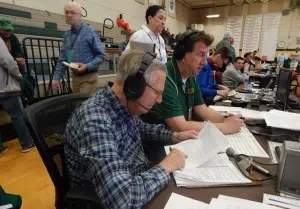
[In photo above, legendary sports reporter and broadcaster Fowler Connell – (in foreground) – checks stats as Eisenhauer talks on-air next to him. The lady behind them is Jeani Cooke, a Tournament Director and Executive Director of the Danville Area Convention and Visitors Bureau. Eisenhauer is also Danville’s mayor, but he uses one of his vacation weeks from that position to help out with the tournament.]
Jeff Rush, the Instructional Media Coordinator for Danville Area Community College, notes the television coverage has also changed.
 ”When it first started out this audio and video setup was under the bleachers. Now we’ve got our own room. We share it with the stats department. It used to be VHS – video tape…well, we’re now DVD and we are also streaming it. That wasn’t even thought of 25 years ago,” said Rush. ”Everything has started going digital – as everybody knows. It’s past the analog – which is the old big T-V’s. We’re now going to the flat-screen T-V’s digital – high definition.”
[In the photo above Rush (on right) gives instructions during one of the games in the control room. Note: You can click on the photos to enlarge them.]
Rush says there is a lot going on during the games in order to provide the audio and video feeds.
”We provide all of the video and audio for the tournament. The video and audio goes to the hospitality rooms – both player and coaches hospitality room. We record disc here that we give to the referees after the game. The coaches like it,” said Rush, ”and then we sell them to the fans if they want them. One other thing that we do, also, is our camera feed video – we send out to our streaming guy….and he streams it onto the internet so the whole world can listen and watch.”
Rush depends on volunteers to man the four cameras covering the games.
”We’ve had kids from the age of seven up to adults in their eighties operating these cameras. We talk to them through a headset, so we’re constantly communicating,” said Rush. ”The main thing that I like them to do is keep the ball in the frame. If they do that – between the four cameras that we have — we can choose one of them that would be usable to go out on air. — So keep the ball in the frame and we’re doing good.”
This year eighteen students from a DACC Journalism 110 TV Production class have been helping….manning the cameras for three games each. Rush says he appreciates their help plus the help of all the other volunteers who make it all possible.