A dangerous new fungus called red crown rot is popping up in soybean fields all across the state. Greg Bishop has more….
“We are worried. We are interested in learning more about the spread, and most importantly, management, because this is something that is not going to go away,” said Stephanie Porter, agronomist with the Illinois Soybean Association.
Agronomists need farmers to walk their fields in July to look for infected plants. Farmers are being asked to dig up the plants and send them to state diagnostic plant clinics. By August, the distinctive reddish color on the crown and roots of the plant will blacken, making the condition too difficult to diagnose, Porter said.
Robert Bellm, retired researcher from University of Illinois Extension, offered some scouting tips.
The R3 to R4 growth stage is the optimum time to spot the disease. Infected plants can’t be spotted from the road. Look for chlorotic or necrotic leaves or wilting plants. High moisture later in the growing season allows a toxin to move up the plant, causing yellow blotches between leaf veins. Red crown rot can be confused with brown stem rot. Look for reddening at the crown or the base of the stem or the roots. Infected plants can be easily pulled up from the soil.
If there is moisture, there may be red fungal structure or perithecia. The roots of the plant will appear rotted.
Red crown rot first showed up in Pike County in 2018. Now it is popping up all over the state, Porter said.
Steve Clough, USDA plant pathologist at the University of Illinois Campus in Urbana, is one of the scientists who is anxious to examine more plant samples, Porter said. The disease is spread through water and on machinery. On his blog ILSoyAdvisor, Clough noted that there is a very unusual distribution of red crown rot across the country.
“This disease produces microsclerotia and these structures can be spread by wind and equipment,” Clough said.
Later planted soybeans seem to be more at risk for the disease. A seed treatment from Syngenta has been shown to offer some proactiveness to halt the disease.
Red crown rot can cause very high infection and yield loss, Porter said. Applying fungicides will not halt the disease spread. Rotating out of soybeans for two years is recommended.
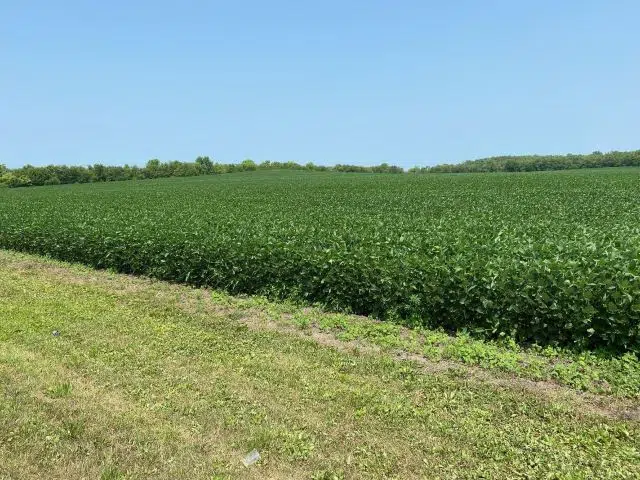
{The photo above is of a soybean field near Westville. The story is from Illinois Radio Network News.}