THE FOLLOWING IS A NEWS-GAZETTE ARTICLE BY JENNIFER BAILEY
GEORGETOWN — Fifty-six-year-old Donna Ross keeps close-by comforts — stashes of cigarettes and cans of soda — within easy reach of her living room couch, though she’s been working at cutting down on both of those addictions in the last couple months.
Ross said she was consuming nine cans of soda with sugar per day, and now she has cut that by more than half. She’s also lessened her cigarette smoking, started exercising and is doing well at losing weight.
As the first client of the new Carle Community Health Worker Program in Vermilion County, Ross is motivated in making strides toward healthier habits.
The community health workers, through Carle’s Community Health Initiatives Program, help with connecting Vermilion County residents, mostly referred by Carle doctors, with resources.
The program is supported by federal funding, a health initiatives grant administered through the Illinois Department of Healthcare and Family Services.
The community health workers develop relationships with the clients, going beyond just brief doctor and patient visits.
The workers visit the clients’ homes once a month and help connect clients to healthcare services.
According to Carle, “community health workers act as a bridge from the client’s primary care provider to vital healthcare services, community organizations and agencies. Looking at non-medical factors that influence health outcomes, each worker meets individuals where they are in life by conducting home visits and coming up with ways to help clients overcome obstacles and barriers to living their best lives.”
Ross was referred to the program by her primary care provider at Carle at the Riverfront. She’s currently one of the program’s 33 active patients out of 40 registered.
One tool Ross has been provided with is a calorie counting app on her phone to help her lose weight.
In addition to such tools, the workers provided support for each client, regularly checking in on their progress.
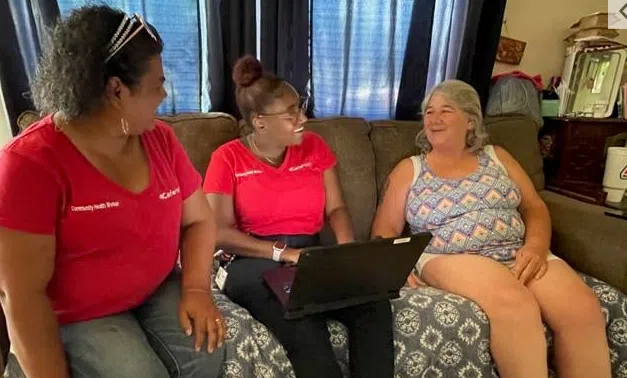
Community Health Worker supervisor Maria Sermersheim has been Ross’ community worker for the past three months. Jasmine Venable also has been working with Ross.
At Sermersheim’s last visit with Ross, she told Ross she looked good.
Ross’ health issues include hypertension, COPD (chronic obstructive pulmonary disease), and arthritis in her knees. She also has had seizures and has passed out multiple times.
Venable said they were initially coming to check on Ross once a week the first month, then came biweekly if the schedule permitted. If Ross had a doctor’s appointment in between visits, they’d also see her there.
“I really, really am glad that they come and see me. Because when I got sick this last time, and I was passing out, thank goodness that Maria was here because she talked me into going to the doctor and then they sent me to the hospital emergency room,” Ross said. However, Ross said she hasn’t really found out what’s going on with her.
Any surgery on her neck has to wait until she stops smoking and they find out why she’s passing out.
“I’m working on everything,” Ross said.
She said she’s made one goal, to lose weight. She started at 215 pounds and got down to 209.
Ross has cut back to drinking three sodas a day now from her previous nine cans a day.
She also said that when she goes for a donut, she now only eats one and not multiple, because she knows it will put weight on her.
Ross too has increased her walking for exercise. She walked three miles recently at Forest Glen Preserve.
“I do feel better, and I can tell that I’ve lost some weight,” she said.
Ross, who has three children and 13 grandchildren, said that if she can do it and make changes, anybody can do it if they want to.
Venable said that after six months they will do a re-evaluation with Ross for discharge. If they see there are more things they can continue with in working on goals, they can extend the time; or if things are going great, they leave it up to Ross to decide.
“I just love them to death,” Ross said. “Every time I don’t get to see Jasmine, I will ask Maria, where’s Jasmine? I like Jasmine. She’s such a sweetheart. Her and Maria, they are just lovable. You could not turn them down.”
Ross still wants to quit smoking. She was smoking three packs a day, got down to two packs a day and was at a half pack. Now she’s back at one pack.
She’s getting ready to move again from staying with her son and will soon have her own place again.
Venable has 13 clients, another co-worker has about 16 others, and Sermersheim has had five throughout Vermilion County. Venable said that on the day she visited Ross, she had gone to a client’s home in Catlin that morning.
“The program is definitely growing, and Donna is the blueprint,” Venable said.
Ross said the workers are “wonderful people. I’d like to see them get more and more people, because I know they can do it.”
In addition to doctor referrals and working with Medicare and chronic diseases, the program is exploring Medicaid too and referrals from other organizations, such as East Central Illinois Community Action Agency, Venable said.
Venable said when they first meet for an appointment, they meet with the client for an hour and a half. Hour-long appointments follow.
“We do a matrix, it’s a survey, and we just ask them those survey questions and it gives them a score on what they might need help with. It helps us form goals and base the goals,” Venable said.
Sermersheim said the clients have chronic illnesses, such as diabetes, hypertension, congestive heart failure, a nutrition need or any cancer screening that hasn’t been completed. They must live in Vermilion County.
The program started with Carle at the Riverfront patients three and a half months ago. After those referrals, Sermersheim said they started calling patients on a list of those who haven’t seen a provider in 12 months.
They have seven clients currently referred by doctors.
Sermersheim said Ross has done a great job in starting to lose weight. She said Ross told them that she would get stuck at a certain weight and then it’s harder to lose more.
“Well now you have us,” she said she told Ross.
“We come to their home to help them live with their chronic illness and help them so they can live with dignity,” Sermersheim said.
She added that most people don’t know all the resources available in the community. Some don’t go to the doctor because they don’t have money for gas for their vehicle or they need to feed their family and can’t afford their medicine.
“We help with that,” Sermersheim said.
Local organizations, including churches and nonprofits, can help with transportation and gas cards. They’ve assisted some people too with gardening.
Ross also requested psychology and psychiatry services.
“We help them navigate,” Sermersheim said.
The community health workers can help keep the clients motivated toward their goals, but Ross and the others are making their goals happen.
“She’s an amazing, strong lady that just needed somebody to support her and she’d have done it,” Sermersheim said. “And we have many other clients, (that’s) what they needed, just a little push (and to make those connections).”
Carle is monitoring the program, and may duplicate it in other counties.